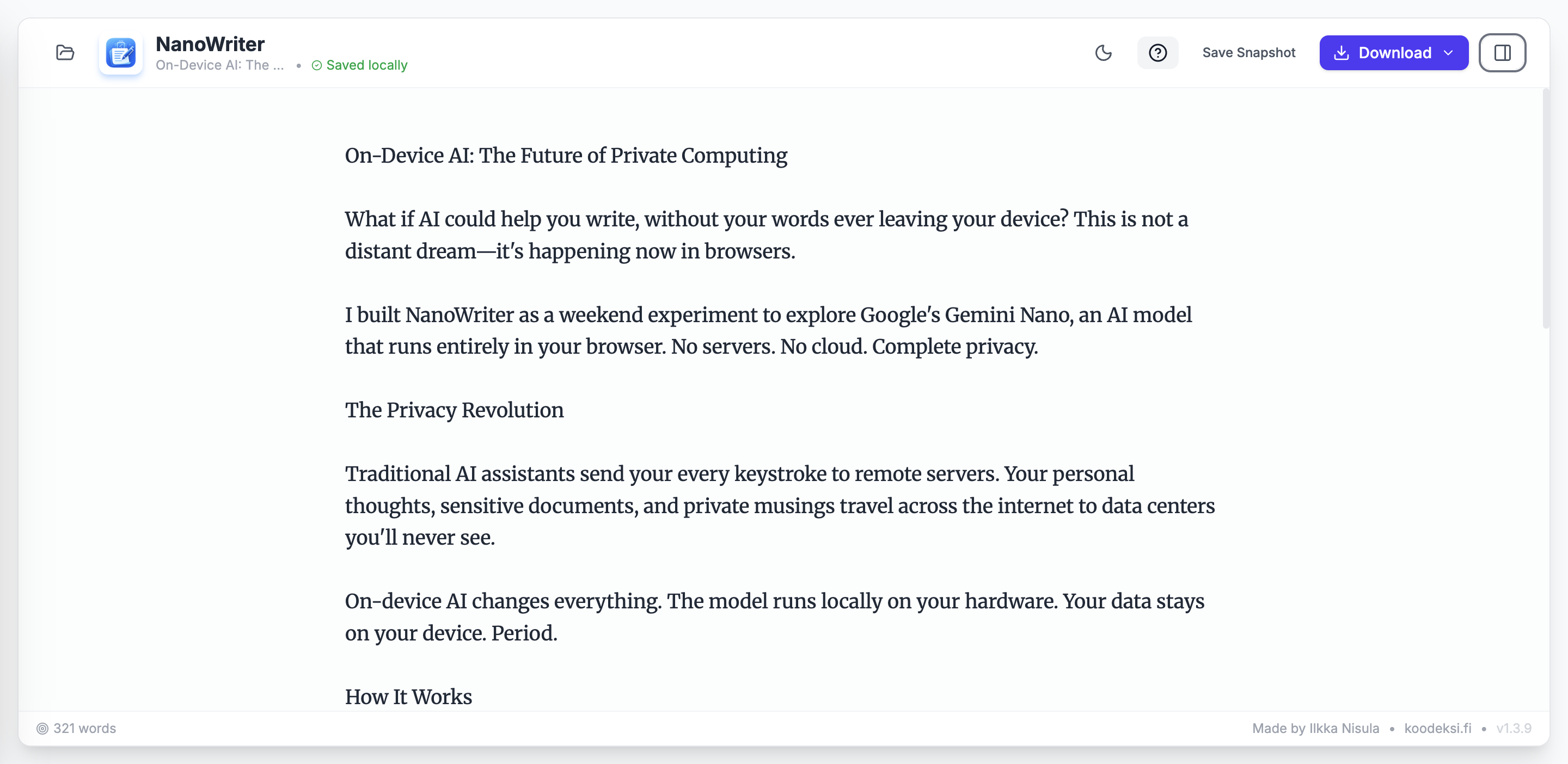
On-Device AI: The Future of Private Computing

What if AI could help you write, without your words ever leaving your device? This is not a distant dream—it's happening now in browsers.
I built NanoWriter as a weekend experiment to explore Google's Gemini Nano, an AI model that runs entirely in your browser. No servers. No cloud. Complete privacy.
Privacy by Default
Before SaaS became mainstream, keeping data on your device was the norm. Most AI assistants today send your keystrokes to remote servers—your thoughts traveling to data centers you'll never see. On-device AI brings back privacy as the default.
The model runs locally on your hardware. Your data never leaves your device—and with no internet connection required, the security becomes physical. There is simply no network path for your data to travel. While local models won't match the sophistication of cloud-based AI, they serve a clear purpose: enabling AI assistance without sacrificing privacy.
How It Works
Chrome includes Gemini Nano, a compact language model that downloads in the background (~2 GB). Once loaded, it runs entirely on your device using GPU or CPU. The model supports English, Spanish, and Japanese.
NanoWriter uses Chrome's built-in AI APIs to provide real-time writing suggestions. As you type, the AI analyzes your text and offers improvements—all without any network requests.
When Is This Coming?
Chrome's built-in AI APIs are available now for developers behind feature flags. The Prompt API, Summarizer API, Writer API, and Translator API are progressing through the W3C standardization process. Chrome 140+ includes Gemini Nano with multilingual support.
These APIs are expected to become generally available in 2026 as browser standards mature. You can experiment today by enabling chrome://flags/#optimization-guide-on-device-model and chrome://flags/#prompt-api-for-gemini-nano.
Why This Matters
Imagine writing in a coffee shop, on an airplane, or in a location with no internet—and still having AI assistance. Imagine discussing sensitive topics without worrying about data breaches. This is the promise of on-device AI.

Privacy in public spaces
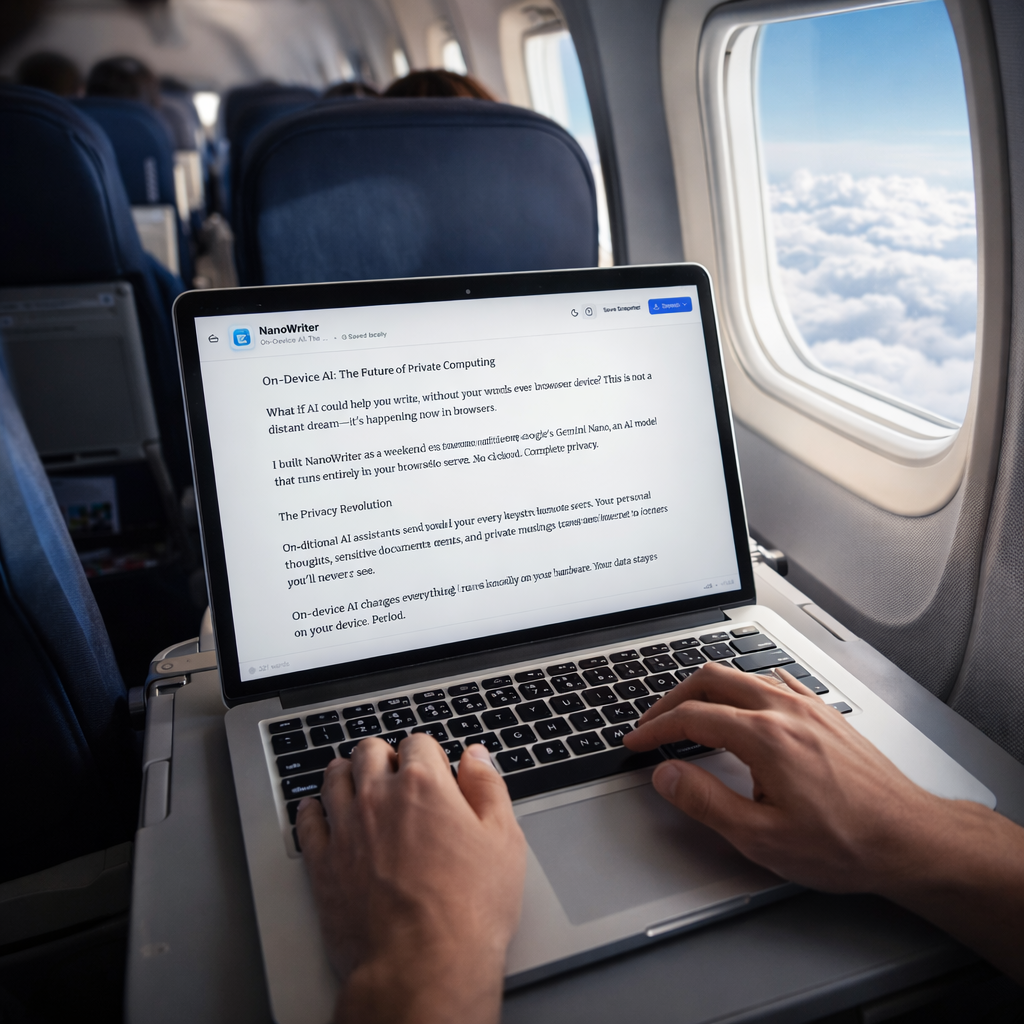
Works offline at 35,000 feet

Create anywhere, no connection needed
NanoWriter demonstrates what is possible today. Built in a single day using AI-assisted development, it shows that privacy-first AI tools are within reach for any developer willing to experiment.
Try It Yourself
Visit nanowriter.koodeksi.fi to experience on-device AI writing assistance. Enable Chrome's experimental AI features in chrome://flags and see the future of private computing firsthand.
 Try NanoWriter